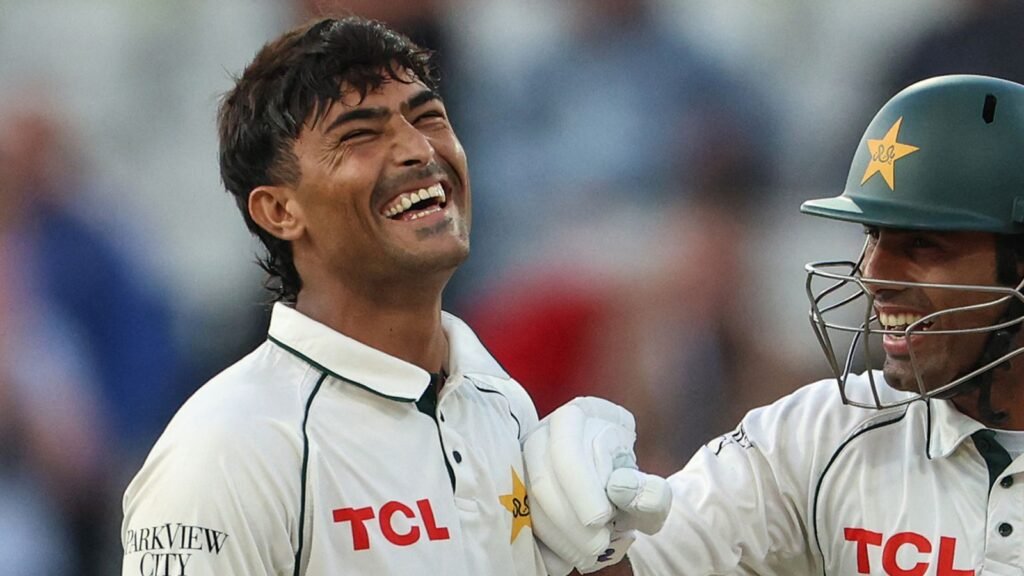
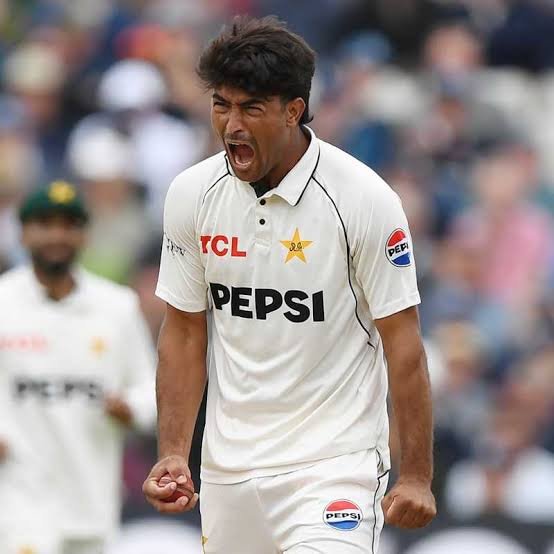
Pakistan cricket has found another fast bowler who makes people stop and watch. Razaullah Mashwani’s remarkable Test debut against England at Edgbaston was another reminder of something Pakistan has known for decades: this country does not suffer from a shortage of cricketing talent. It suffers far more from its inability to consistently manage that talent once it has been discovered. The real challenge for the Pakistan Cricket Board is therefore not finding the next Razaullah. It is making sure that he does not become another story of enormous promise interrupted by injury, poor planning or premature burnout.
At 21, Razaullah has already shown qualities that cannot easily be taught. He has genuine pace, confidence against international batters and, as his explosive 81 from No. 9 demonstrated, considerable natural ability with the bat as well. Pakistan should celebrate his arrival.
But celebration must come with caution.
Pakistan cricket has seen this movie before.
Ihsanullah emerged from the PSL bowling above 150 kilometres per hour and looked capable of becoming a major international fast bowler. Then came an elbow injury and a prolonged absence. More troublingly, the PCB’s own independent medical committee later identified delays in diagnosis, inappropriate treatment and the absence of the formal rehabilitation his condition required. The committee also acknowledged that Ihsanullah himself had not fully complied with rehabilitation protocols, but the institutional failures were serious enough to raise fundamental questions about how elite young athletes were being medically managed.
He is not an isolated example.
Naseem Shah was only 20 when a shoulder injury during the 2023 Asia Cup required surgery and ruled him out of the World Cup. Mohammad Hasnain suffered an ankle injury requiring extended rehabilitation. Mohammad Wasim Jr later underwent rehabilitation for a back injury. Arshad Iqbal and Zeeshan Zameer have also faced significant injury problems requiring specialist treatment.
Shaheen Shah Afridi’s injury history has similarly forced repeated discussion about workload and rest. The PCB itself has acknowledged the importance of rotation and workload management for fast bowlers, particularly after Pakistan entered major tournaments without key pacers fully available.
Not every injury can be blamed on the PCB. Fast bowling is physically demanding and injuries are an unavoidable part of professional sport. But when promising fast bowlers repeatedly suffer serious setbacks at young ages, the correct response is not simply to call it bad luck. The system has to ask whether workloads, rehabilitation, scheduling, medical supervision and selection decisions are good enough.
That is why Razaullah should not simply be encouraged to bowl faster.
Pakistan has a fascination with the speed gun. A young bowler reaches 145 km/h and immediately the question becomes whether he can reach 150. Yet longevity in international cricket comes from much more than pace.
Razaullah must be developed as a complete bowler: movement with the new ball, control with the old ball, variations, yorkers, tactical awareness and the ability to maintain effectiveness even when maximum pace is unnecessary.
His workload should also be monitored scientifically. Domestic cricket, Test matches, white-ball internationals, the PSL and overseas leagues cannot be treated as separate worlds. To a fast bowler’s body, an over is an over regardless of which shirt he is wearing.
The PCB should therefore prepare individual development programmes for its leading young fast bowlers, covering bowling loads, strength training, nutrition, recovery, injury prevention and planned rest.
And rest must stop being viewed as weakness.
Sometimes protecting a bowler from one tournament may preserve him for another five years.
Razaullah’s batting should also be developed rather than dismissed as a one-off performance. An 81 from No. 9 suggests natural lower-order ability. Pakistan does not need to turn him into a specialist batsman, but a fast bowler capable of contributing meaningful runs becomes considerably more valuable.
Above all, Pakistan needs a permanent national pace-development programme in which the PCB, domestic teams and PSL franchises share workload information, medical records and rehabilitation plans.
Pakistan has produced Shoaib Akhtar, Wasim Akram, Waqar Younis and generations of naturally gifted pacers. Even today, the supply of talent has not disappeared.
What remains uncertain is whether the system around that talent has evolved at the same pace.
Razaullah deserves applause for what he has achieved. But the greater responsibility now belongs to those managing him.
Pakistan already knows how to discover fast bowlers.
It must finally become equally good at keeping them fit, improving them patiently and allowing their talent to fulfil its promise.