Digital citizen empowerment: A systematic literature review of theories and development models
Sharma, S., Kar, A. K., Gupta, M. P., Dwivedi, Y. K., & Janssen, M. (2022). Information Technology for Development, 28(4), 660–687. DOI: 10.1080/02681102.2022.2046533.
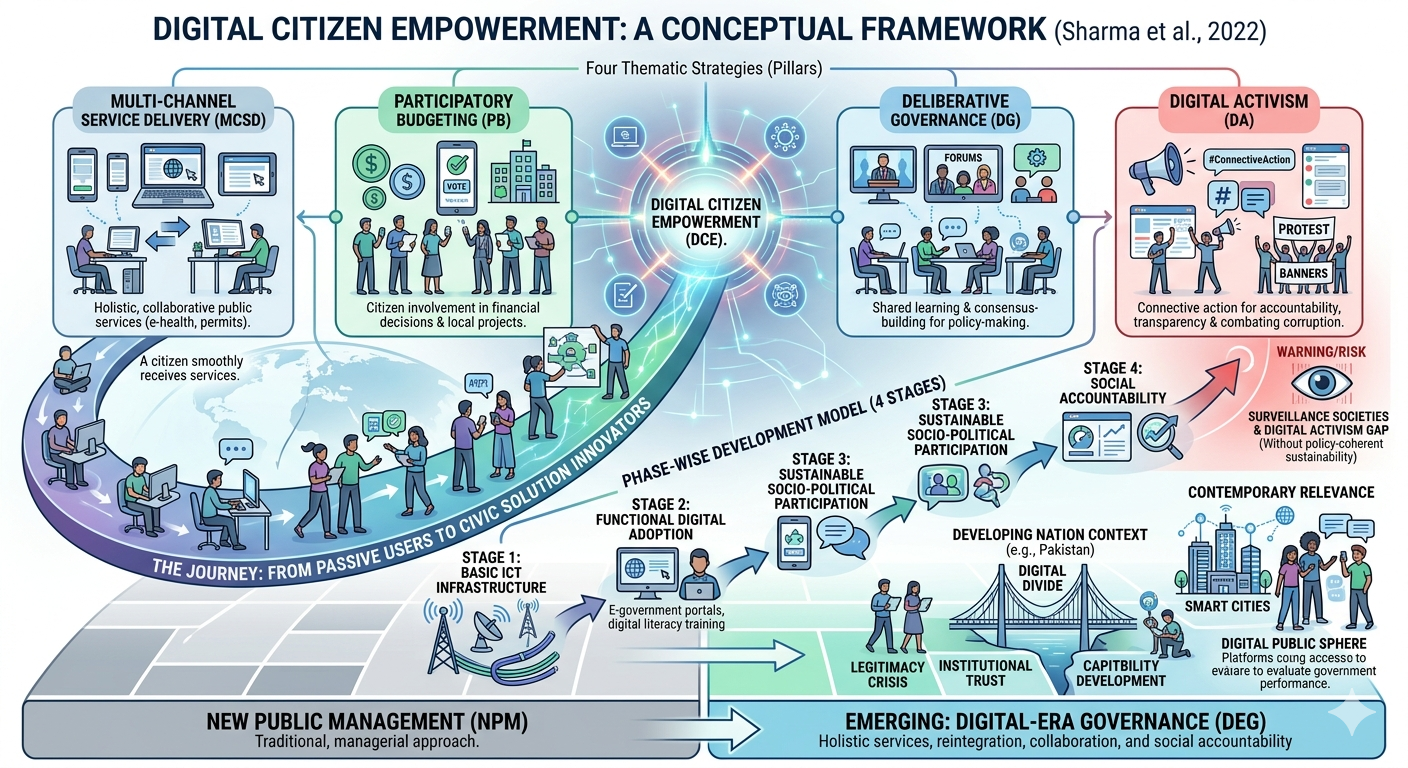
This sophisticated systematic literature review synthesizes two decades of interdisciplinary research to chart the evolution of Digital Citizen Empowerment (DCE), a process that transforms individuals from passive users into civic solution innovators. By analyzing 72 core articles from the Scopus and Web of Science databases, the authors identify four thematic strategies that define the state-citizen relationship: Multi-channel Service Delivery (MCSD), Participatory Budgeting (PB), Deliberative Governance (DG), and Digital Activism (DA). The study argues that the world has shifted from traditional New Public Management toward Digital-Era Governance (DEG), which focuses on reintegrating administrative infrastructure to provide holistic, collaborative services that empower the marginalized. Crucially, the authors present a four-stage conceptual model for the phase-wise development of information societies, moving from basic ICT infrastructure to a digitally connected ecosystem characterized by sustainable socio-political participation and social accountability.
For developing nations like Pakistan, where democratic consolidation is often hindered by elite capture and the digital divide, these findings offer a vital framework for institutional reform. The research highlights that ICT can serve as a “leveler” for social barriers, provided that governance shifts toward a citizen-centric capability development approach rather than a top-down technocratic one. For the Pakistani context, the transition toward deliberative platforms—where policy decisions are based on shared learning and consensus-building—could mitigate the “legitimacy crisis” by fostering trust between the state and its citizens. The study’s emphasis on social accountability (demand-side) provides a roadmap for civil society organizations to hold government officials responsible, ensuring that digital services translate into tangible public value rather than reinforced managerialism.
In a contemporary political climate defined by the rapid digitalization of the public sphere, this study addresses the urgent need to balance state power with active citizen intervention. The research is particularly relevant today as governments worldwide invest in smart cities, where the credibility of decisions increasingly depends on the quality and sustained engagement of the citizenry. For the modern youth, digital platforms have become a primary space for political discourse; this study explains how these interactions can be harnessed for connective action to evaluate government performance and combat corruption. It serves as a scientific warning that unless digital initiatives are designed with policy-coherent sustainability, they risk creating “surveillance societies” that worsen the digital activism gap among vulnerable populations.
This pioneering systematic review provides a robust foundation for fellow scholars to explore the psychological and structural determinants of political participation in the digital age. Future research should build upon this model by investigating the role of behavioral strategies in promoting high-quality civic engagement and examining how the triadic model of State-Citizen-Service Providers affects the flow of accountability. There is immense potential to explore the “wisdom of the crowds” through crowdsensing to monitor local administration and enforce transparency in volatile democratic environments. By continuing to investigate these four strategic streams, the academic community can inspire a new generation of researchers to bridge the gap between technological deployment and the actualization of human dignity in our global information societies.