Patterns of Socio-Political Participation in Nepal and Implications for Social Inclusion
Haug, M., Aasland, A., & Dahal, D. R. (2009). Forum for Development Studies, 36(1), 105-136. DOI: 10.1080/08039410.2009.9666427.
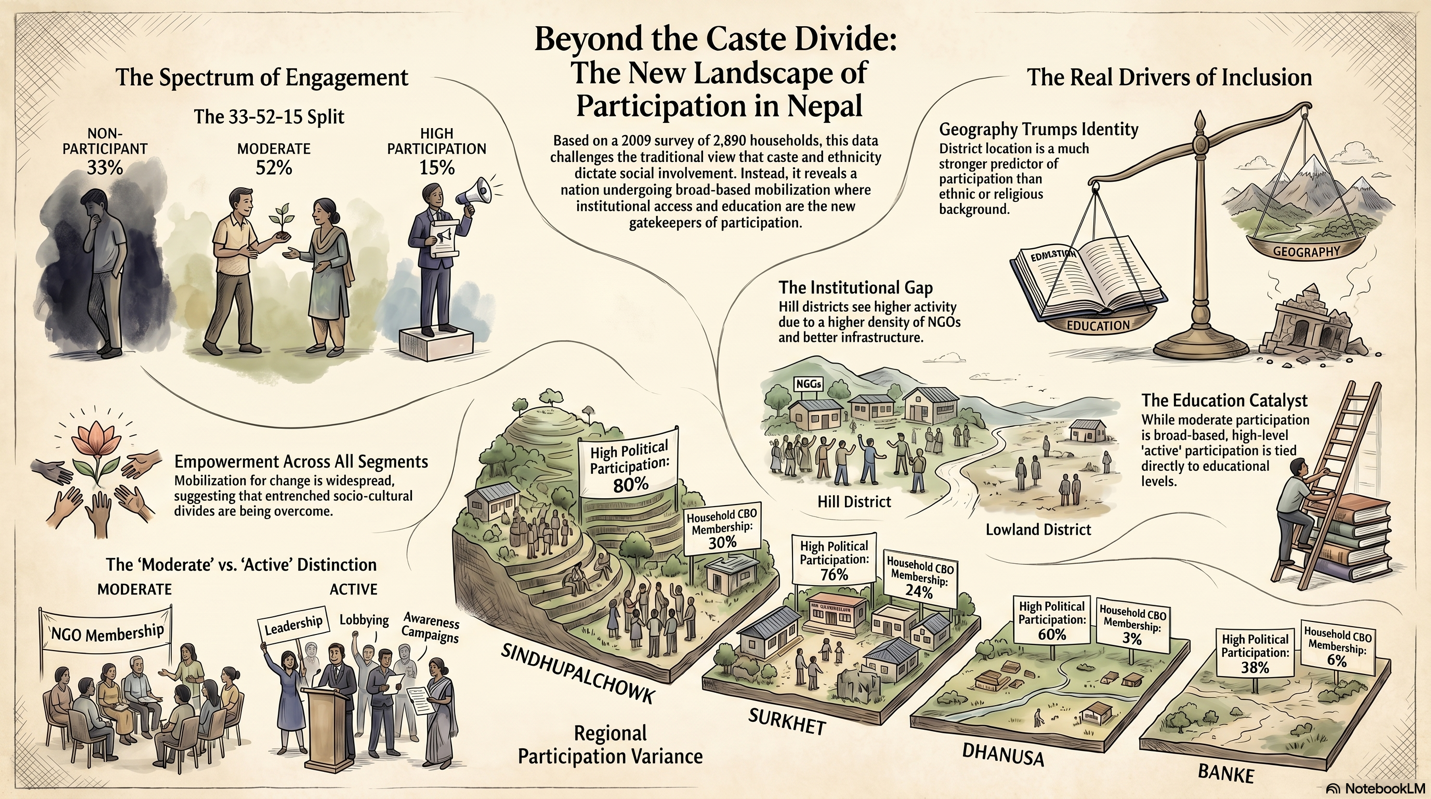
This seminal study utilizes a comprehensive survey of 2,890 households across four distinct districts in Nepal to challenge long-held assumptions regarding the role of caste and ethnicity in political engagement. By constructing a sophisticated participation index, the authors categorize households into non-participants (33%), moderate participants (52%), and active participants (15%). The core findings suggest a significant departure from traditional “ethnic determinism”; instead, the research reveals that geographical location and cultural values are the primary drivers of moderate participation, while educational attainment serves as the critical gatekeeper for high-level, active political leadership. This empirical evidence indicates that a broad-based process of inclusion has taken place, where formerly marginalized groups have been mobilized into the democratic fold, effectively eroding participation gaps previously defined solely by ethnic or class hierarchies.
The broader implications for developing democracies, including Pakistan, underscore that structural mobilization can successfully bridge deep-seated socio-cultural divides even in highly stratified societies. The study demonstrates that civil society organizations and political parties have been remarkably effective in empowering the poor and marginalized to affect change from below. However, a sobering reality remains: because active participation and leadership roles are heavily correlated with human and economic resources, there is a persistent risk of continued elite dominance in positions of power. For practitioners, this suggests that simply increasing turnout is insufficient; the focus must shift toward democratizing the “active” tier of participation by making education and resources more accessible to those traditionally excluded from leadership.
In today’s volatile political climate, where many nations grapple with a “legitimacy crisis,” this research highlights the critical role of subjective perception in driving civic engagement. The authors found that a household’s subjective feeling of being excluded from the national mainstream is a more potent predictor of non-participation than their objective ethnic or religious identity. This finding is particularly relevant for the South Asian context, where political cynicism often stems from a perceived disconnect between the state and the citizen. It reinforces the idea that political participation is itself a constituent element of inclusion; the act of engaging in the process fosters a sense of national belonging that can stabilize fragile democratic systems.
This groundbreaking work invites future scholars to explore the institutional opportunity structures that vary across different regions to explain why certain locales foster higher engagement than others. While this study identifies education as a key driver of leadership, fellow researchers should investigate the specific types of “interpersonal communication” and “digital socialization” that might allow less-educated citizens to overcome traditional barriers to entry. Additionally, there is a significant need to probe how donor-funded NGOs and community-based organizations can better balance their reach between hill and plains regions to avoid creating new geographical imbalances in political agency. By building upon this rigorous multivariate framework, we can deepen our collective understanding of how to transform high levels of public activity into truly non-discriminatory and effective institutional practices.