A scientific approach to measure public political participation in Pakistan
Mangi, S. N., Shah, N., & Soomro, B. A. (2019). Asian Journal of Political Science, 27(1), 88–107. DOI: 10.1080/02185377.2019.1576056.
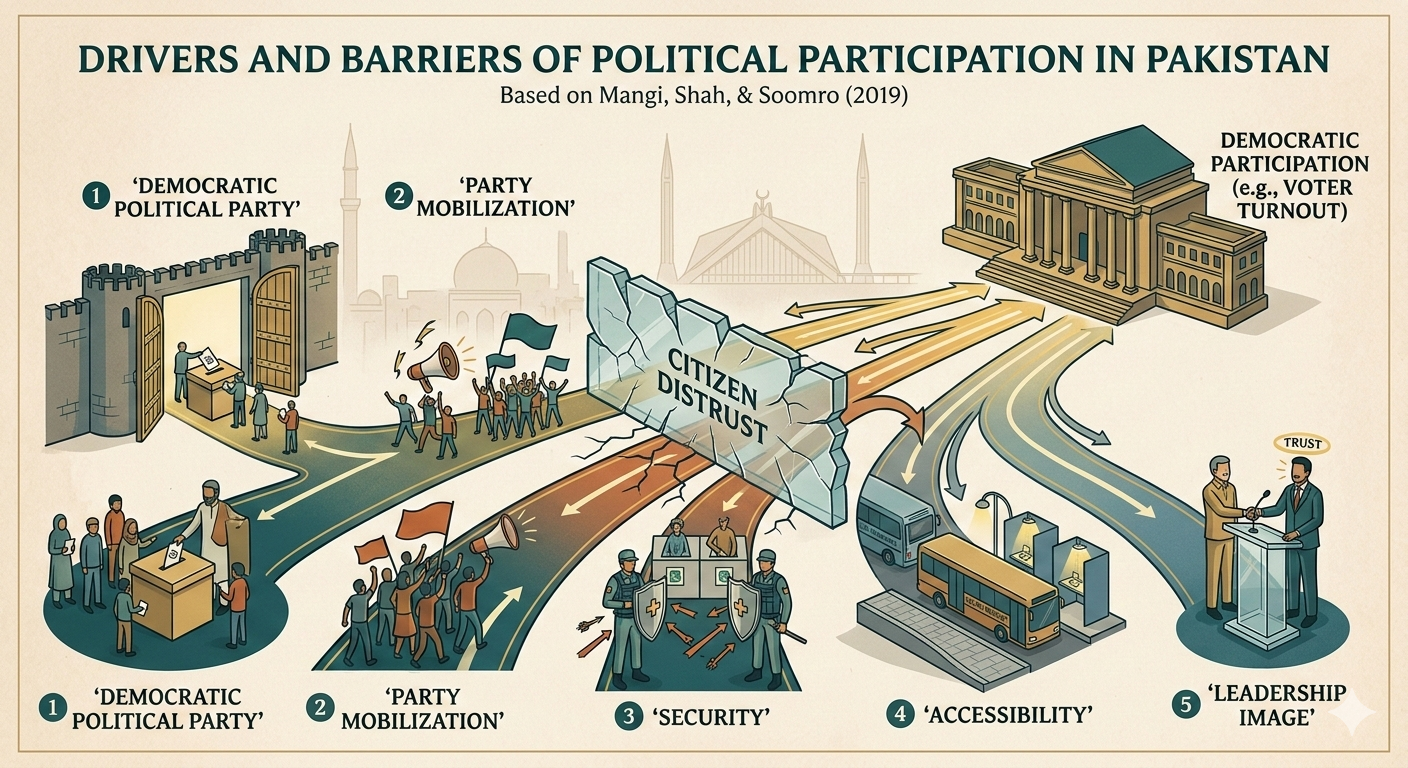
The study provides a rigorous quantitative investigation into why Pakistan ranks 164th globally in voter turnout, utilizing a robust nationwide sample of 1,884 respondents. By employing confirmatory factor analysis and stepwise hierarchical regression, the authors systematically evaluate five critical determinants of political participation: democratic party structures, party mobilization, security, accessibility, and leadership image. The data confirms that while all five factors significantly drive participation, the political landscape is heavily marred by feudalism and dynasticism, where parties often function to protect elite interests rather than represent the populace. Crucially, the research identifies citizen distrust as a potent negative moderator that dampens the positive effects of these variables, highlighting a profound psychological and structural disconnect between the state and its citizens.
These findings suggest that the path to a consolidated democracy in Pakistan requires more than just regular electoral cycles; it demands the fundamental reform of political parties into truly democratic institutions. For practitioners and policymakers, this research emphasizes that enhancing security and ballot box accessibility—specifically through non-traditional venues like shopping malls or mobile polling stations in remote areas—is vital to capturing disenfranchised voters. On a theoretical level, the study demonstrates that political mobilization and empowerment are far more critical than general education alone in fostering a participatory culture. The evidence indicates that unless parties provide equal opportunities to the middle and lower classes, the legitimacy of the entire democratic system will remain precarious.
In the current political climate, characterized by frequent protests and persistent demands for regime change, this study remains highly relevant by addressing the root causes of low legitimacy and public apathy. The “legitimacy crisis” observed in Pakistan stems from a system where over half the population does not feel it is their duty to vote, a sentiment exacerbated by perceived bad governance, income inequality, and political cynicism. This research offers a scientific framework to understand these grievances, proving that high levels of citizen distrust can neutralize even the most active mobilization efforts or charismatic leadership. It underscores that the contemporary demand for technocratic alternatives is a direct symptom of the failure of traditional party structures to inspire public trust.
This pioneering work opens numerous avenues for fellow scholars to further probe the fragile electoral dynamics of developing nations. Future research should aim to explore the specific roles of the judiciary and the military in shaping political behavior, as well as the impact of regionalism and public apathy on long-term democratic stability. There is also a significant need to investigate how electronic and social media can be leveraged to increase transparency and bridge the trust gap in the electoral process. By building upon this scientific foundation, we can collectively deepen our understanding of how to empower citizens and ensure that the “tilled land” of democracy finally yields a representative and stable harvest in Pakistan