Influence of Political Socialization Agents on Pakistani Youth’s Political Participation: The Mediating Role of Media and Interpersonal Communication
Memon, S., Ishak, M. S., & Hamid, N. A. (2018). Jurnal Komunikasi Malaysian Journal of Communication, 34(2), 121-136.
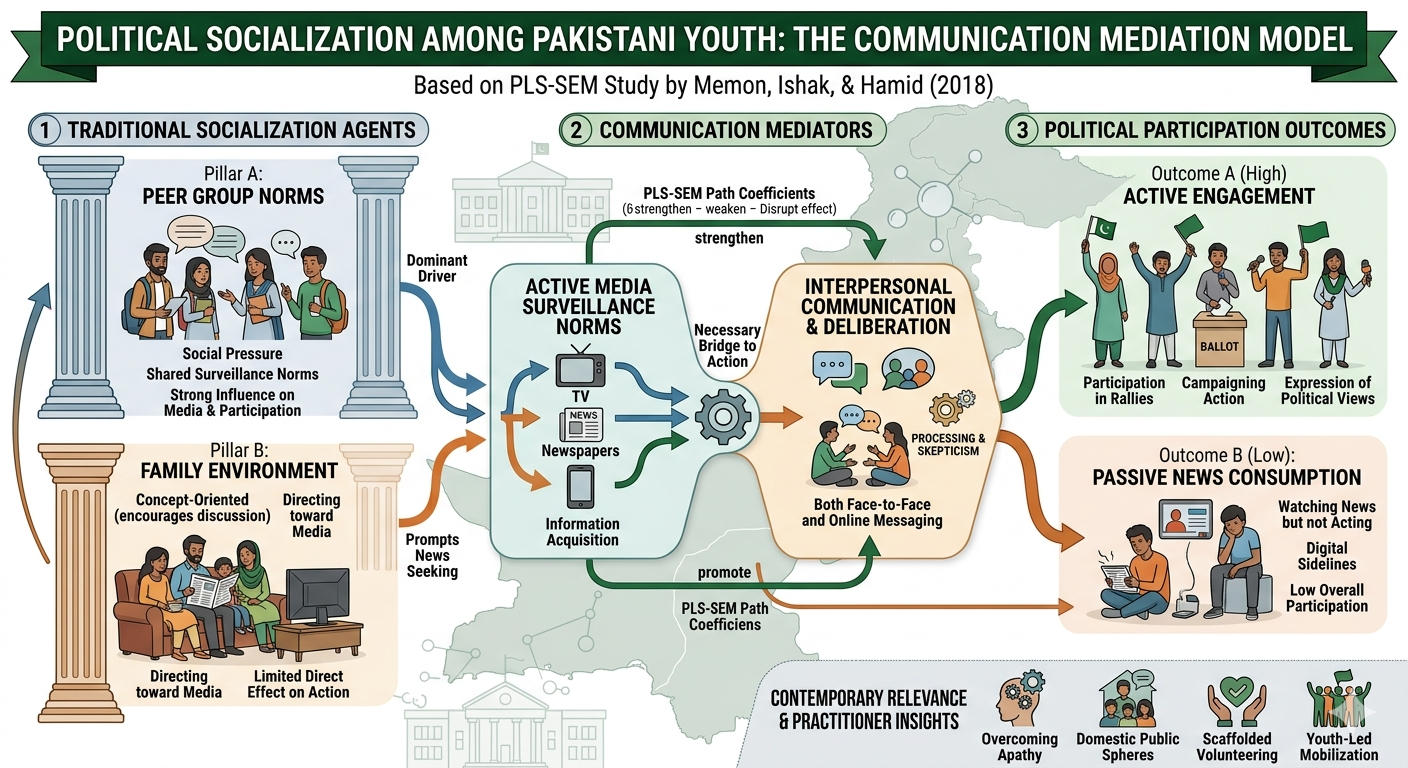
This rigorous investigation utilizes Partial Least Squares Structural Equation Modeling (PLS-SEM) to map the complex pathways through which Pakistani university students are socialized into democratic life. By surveying 228 social science students, the authors move beyond traditional “fixed functionalism”—which emphasizes the mere acquisition of system-maintaining norms—to explore how youth develop the actual capacities for meaningful participation. A primary finding of this research is the overwhelming dominance of peer norms over the family unit in driving both media consumption and political behavior. While a concept-oriented family environment (one that encourages open discussion) successfully prompts youth to seek out news, it does not directly translate into political action. Instead, it is the “media surveillance norms” and social pressure within peer groups that effectively foster the skills and motivations necessary for active engagement.
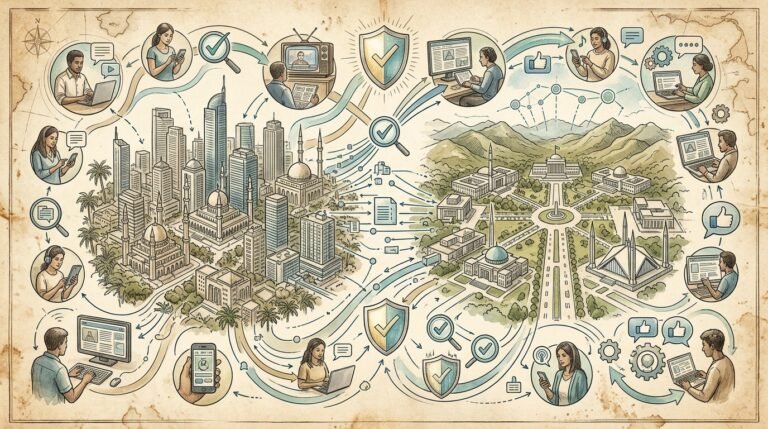
The findings provide a sophisticated empirical justification for the “communication mediation model,” demonstrating that informational media does not act as a “magic bullet” but requires the bridge of interpersonal deliberation to spark action. This suggests that for political participation to take root in the Global South, the mere availability of information through TV or newspapers is insufficient; it must be processed through “interpersonal communication,” including both face-to-face talk and online messaging. For practitioners in Pakistan, these implications are vital: democratic reform must focus on creating “domestic public spheres” and encouraging peer-led volunteering or scaffolding programs that move youth from passive news consumption to active expression.
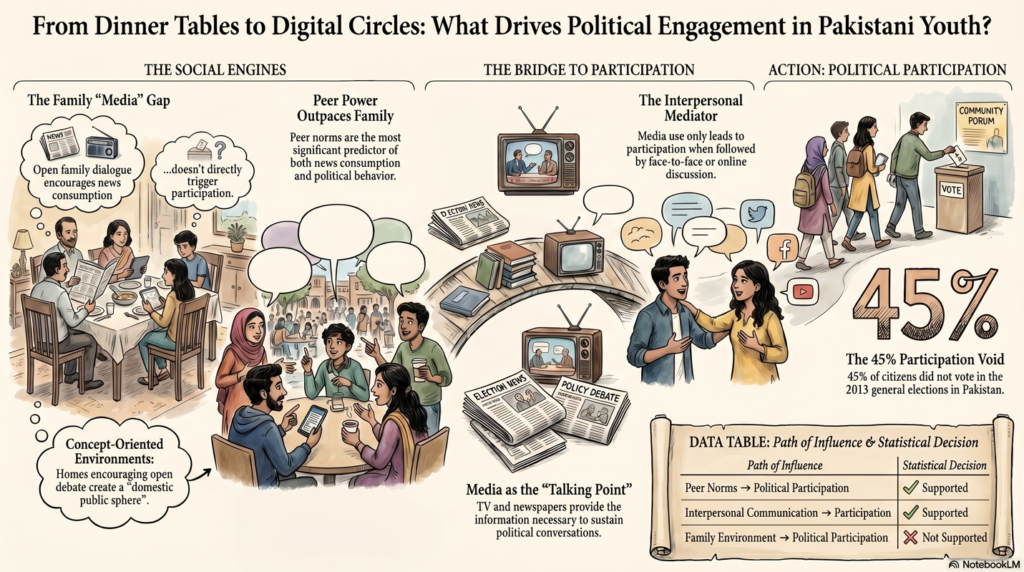
In an era where the “apathetic youth” narrative often dominates political discourse, this study is critically relevant for addressing the persistent legitimacy crisis and low voter turnout in Pakistan. With nearly 45 percent of the Pakistani citizenry remaining inactive in the governing process, understanding that youth respond more to peer-mediated social capital than to traditional top-down socialization is essential for any mobilization strategy. The research highlights that the digital transition has not erased the need for human connection; rather, online messaging now serves as a modern mediator that gives youth the confidence and “talking points” necessary to enter the real-life arena of political contention.
This landmark study serves as a foundational call for fellow researchers to further explore the “dosage versus potency” of digital socialization agents in increasingly polarized environments. Future scholarship should build upon this model by investigating how regional differences—such as the rural-urban divide—might alter the influence of these socialization agents, particularly as individuals age and their dependency on family versus peers shifts. There is also immense potential to explore how specific types of interpersonal communication, such as deliberative versus conflictual talk, affect the long-term stability of democratic values. By continuing this line of rigorous empirical inquiry, we can better understand how to empower the next generation of Pakistani citizens to move from the digital sidelines to the heart of the democratic process.