Media Use and Online Political Participation: The Mediating Roles of Media Credibility and Political Trust in Jakarta and Islamabad
Intyaswati, D., Mahmood, Q., Venus, A., Kusumajanti, & Saputra, W. T. (2025). Journal of Contemporary Eastern Asia, 24(1), 22-43. DOI: 10.17477/jcea.2025.24.1.022.
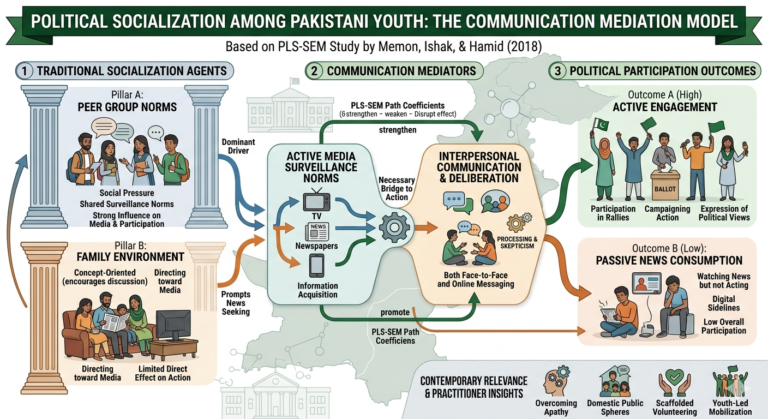
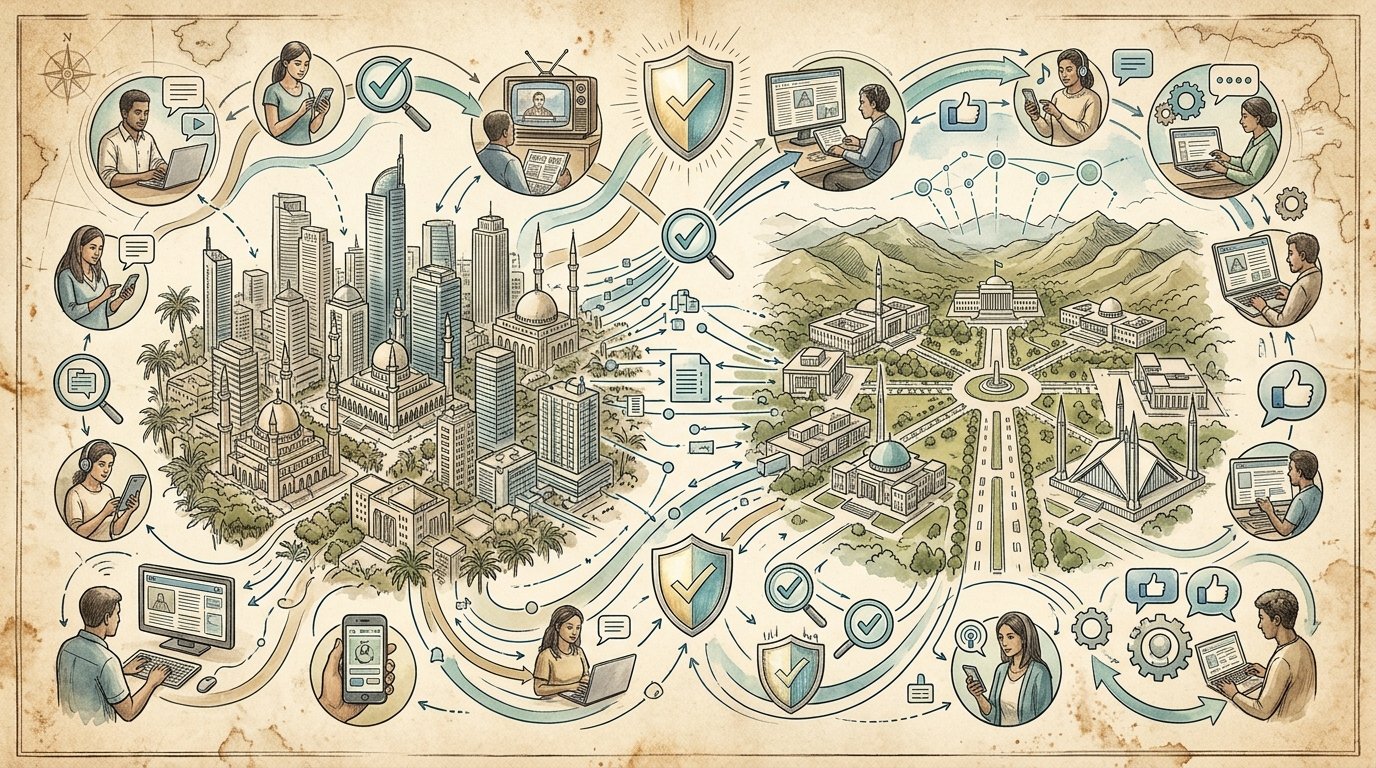
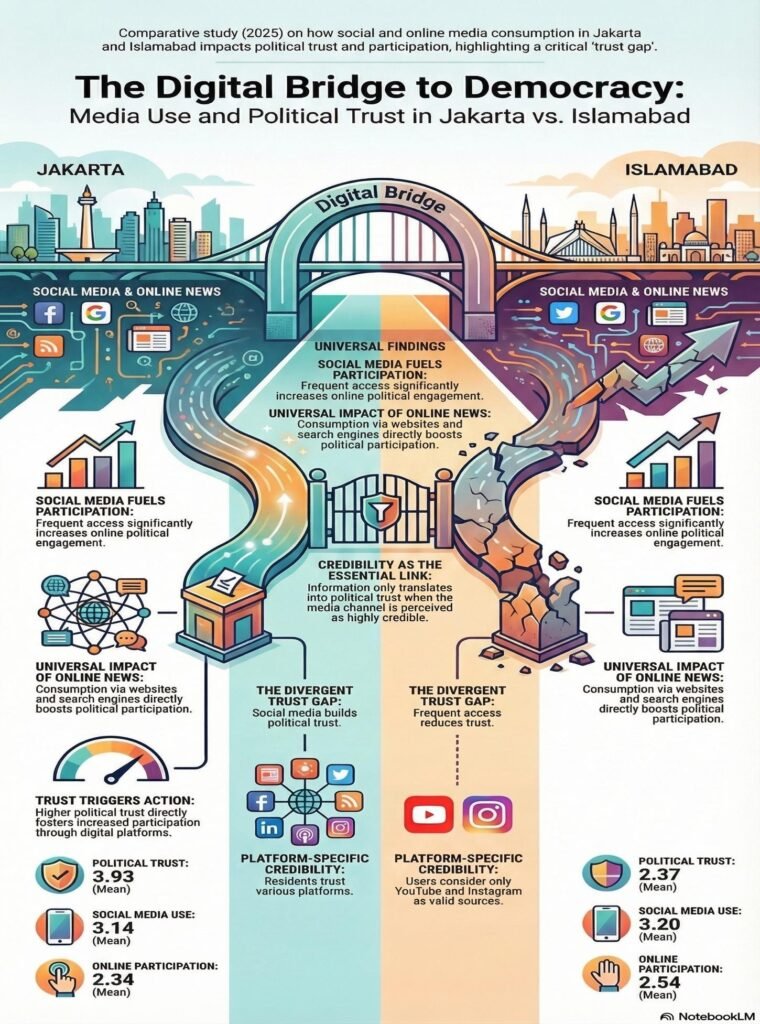
This rigorous comparative study utilizes Structural Equation Modeling (SEM) to explore the intricate pathways through which digital political information consumption translates into online political engagement within two major South Asian and Southeast Asian capitals. By analyzing survey data from 386 residents in Islamabad and 520 in Jakarta, the authors evaluate how media credibility and political trust function as mediating variables in the digital age. A striking finding for political behaviorists is the divergence in trust dynamics: while social media use in Jakarta fosters political trust, frequent access to political information via social media in Islamabad actually reduces confidence in the government and politicians. Methodologically, the research demonstrates high academic standards by employing confirmatory factor analysis, which uniquely identified YouTube and Instagram as the primary valid sources of political information for the Islamabad cohort, while excluding platforms like TikTok and Twitter due to reliability thresholds.
The findings offer profound implications for the study of democratic consolidation in hybrid regimes, suggesting that political trust is a prerequisite for mobilizing citizens, yet the very tools used for mobilization—social media—may be eroding that trust in the Pakistani context. For researchers specializing in third-world political behavior, the study clarifies that online media consumption (websites and search engines) holds a more significant weight in fostering trust in Pakistan than in Indonesia, where social media remains the dominant trust-builder. This implies that for the Pakistani state and political actors to enhance their legitimacy, there is a dire need to shift toward objective, professional journalism and “positive political behavior” to rebuild a shattered image among a tech-savvy but cynical youth population.
In a contemporary era of hyper-polarization and economic volatility, this research is vital for understanding the “legitimacy crisis” that has gripped Pakistan since the political upheavals of early 2022. The study contextualizes its data against a backdrop of military-political shifts, high inflation, and perceptions of systemic corruption within institutions like the National Accountability Bureau (NAB). It highlights that in a climate where residents believe news channels are biased and politicians are dishonest, source credibility becomes the ultimate currency for democratic participation. This study serves as a scientific baseline to understand why certain segments of the Pakistani electorate may engage in online activism not out of trust, but as a reaction to perceived institutional failures.
This landmark comparative work provides a fertile foundation for fellow scholars to pursue longitudinal research into how digital “echo chambers” influence long-term democratic stability. Future scholarship should build upon this model by incorporating more comprehensive indicators of political trust and expanding the geographic scope beyond capital cities to capture rural-urban divides. There is a significant opportunity to explore how specific digital platforms and search engine behaviors allow citizens to bypass domestic media bias by accessing international information sources. By continuing to refine these models of digital mediation, we can better equip the academic community to predict the resilience of democratic institutions in the face of rapid technological and political disruption.