Effects of sociodemographic variables and Facebook group membership on students political participation
Mahmood, Q. K., Bhutta, M. H., & ul Haq, M. A. (2018). Education and Information Technologies, 23, 2235–2247. https://doi.org/10.1007/s10639-018-9715-5.
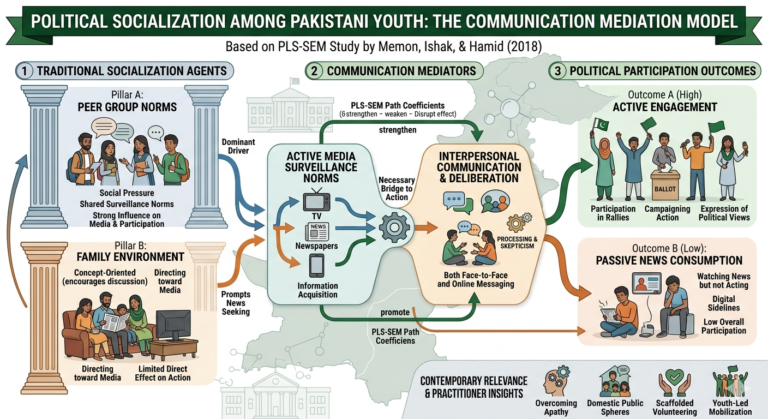
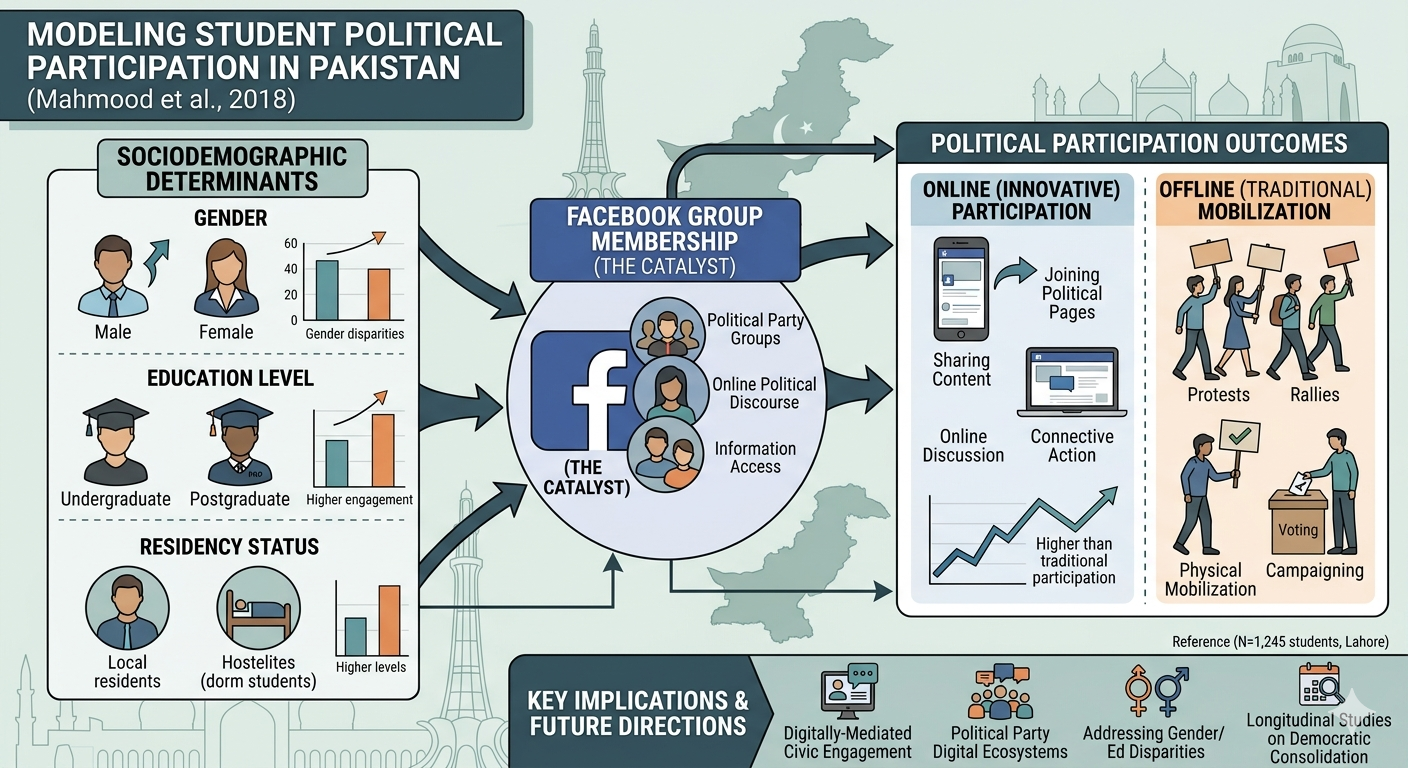
The study provides a rigorous empirical analysis of how the information society is reshaping the political landscape for Pakistan’s youth, utilizing a robust cross-sectional survey of 1,245 university students in Lahore. By employing exploratory factor analysis and inferential statistics, the authors demonstrate that while youth have often been characterized as politically indifferent, they are increasingly engaged in “innovative” political acts, showing a significantly higher inclination toward online participation via Facebook than traditional offline activities. The data reveals that sociodemographic factors—specifically gender, residency status, and educational attainment—play a decisive role in participation levels, with postgraduate students and male respondents consistently exhibiting higher levels of engagement in both digital and physical political spheres. Central to the research is the transformative power of digital affiliation; membership in Facebook groups, particularly those tied to political parties, serves as a potent catalyst that significantly boosts a student’s likelihood of engaging in both online discourse and offline mobilization.
These findings suggest a paradigm shift in how we conceptualize democratic “lubricants” in developing nations, moving away from traditional metrics of participation toward digitally-mediated civic engagement. For the political landscape of Pakistan, the research implies that political parties can no longer rely solely on physical infrastructure but must cultivate sophisticated digital ecosystems to capture the interest of a youth population that increasingly uses social media to bypass traditional informational barriers. Furthermore, the study highlights that digital empowerment is not inherently egalitarian; the persistent gendered and educational disparities in participation suggest that without institutional reform, the digital divide may inadvertently reinforce existing social hierarchies in the Global South.
In a contemporary political climate defined by the rapid digitalization of the public sphere, this research remains acutely relevant as it addresses the “legitimacy gap” between a traditional political class and a tech-savvy generation. As Pakistan’s social media population continues to grow, the ability to mobilize educated youth through targeted Facebook group membership has become a defining feature of modern political movements and electioneering. This study provides the scientific evidence needed to understand why contemporary youth-led movements are increasingly effective: they leverage online platforms to transform individual grievances into collective “connective action” that exerts real-world political pressure.
This landmark investigation serves as a vital call to action for the academic community to move beyond binary views of technology and instead explore the nuanced psychological and environmental factors that drive political efficacy. Future scholarship should build upon this framework by investigating the role of personality traits, political orientation, and the impact of the broader political environment on how online interactions translate into sustained democratic stability. There is immense potential for researchers to conduct longitudinal studies that track how the “wisdom of the crowds” on digital platforms influences actual policy outcomes and the long-term consolidation of democracy in the region.