Major Structural Issues and Measures to Improve Political Participation of Minorities in India
Maidergi, V. K., & M. S., N. K. (2025). Peace Review: A Journal of Social Justice, 37(2), 293–302. DOI: 10.1080/10402659.2025.2495050.
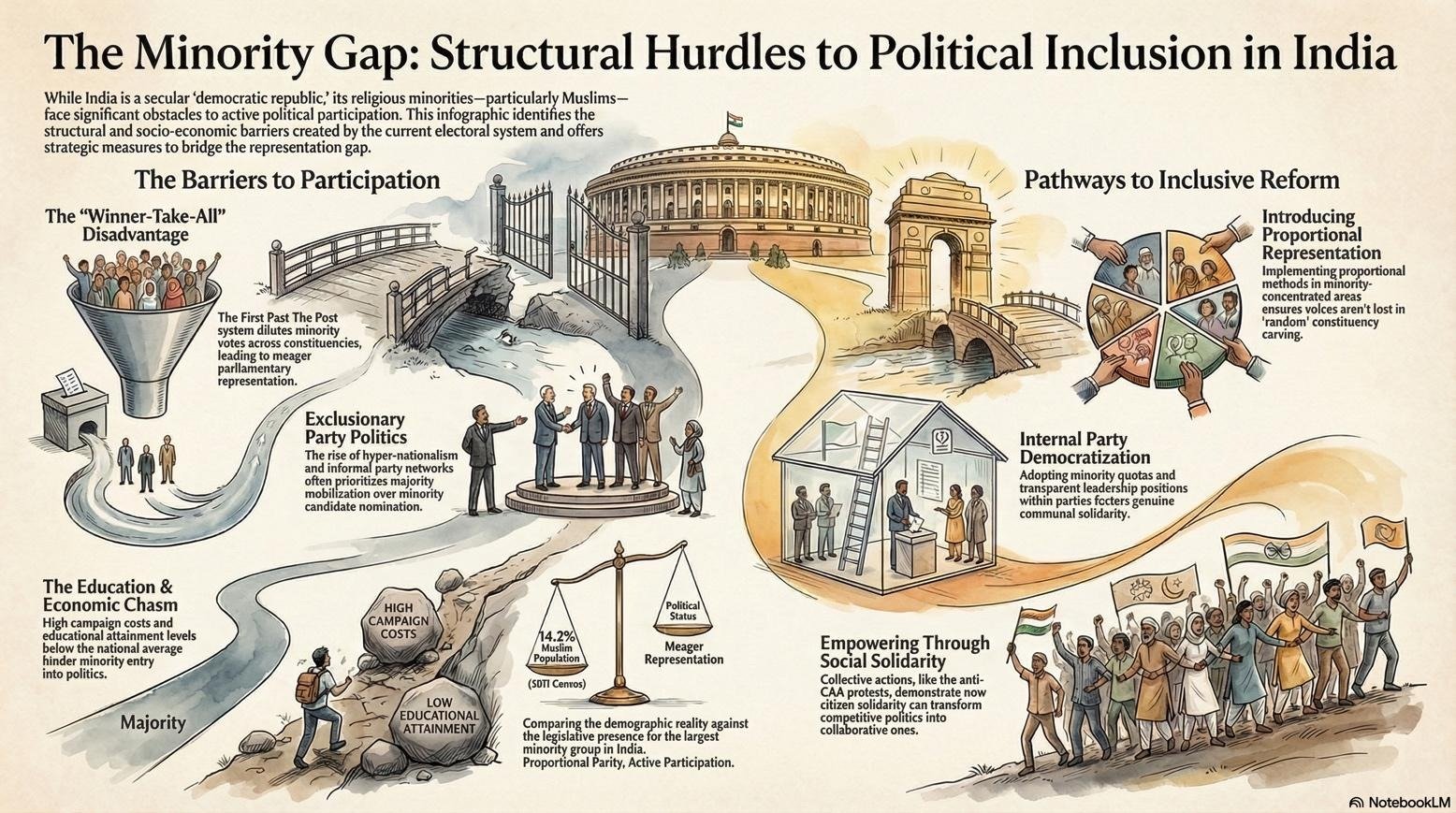
This insightful analysis explores the systemic and procedural impediments that hinder the political agency of religious minorities in the world’s largest democracy. The authors utilize a historical and structural framework to dissect how the “First Past the Post” (FPTP) system, combined with a random delimitation of constituencies, often dilutes minority votes, leading to a “winner-take-all” outcome that strategically excludes geographically dispersed communities. Furthermore, the study identifies a shift from a pluralistic “Congress system” to a contemporary landscape dominated by hypernationalism and religious identity politics, where minority concerns are often sidelined or used as electoral rhetoric. By examining socio-economic barriers like systemic poverty and the educational disparities highlighted by the Sachar Committee, the research argues that the high material cost of political entry effectively disenfranchises those struggling for basic survival.
The evidence presented underscores a critical need for structural reform that transcends simple electoral cycles, offering a blueprint for more inclusive governance in diverse South Asian contexts like Pakistan. The authors suggest that moving toward a hybrid system that integrates proportional representation in minority-concentrated areas could transform “wasted votes” into meaningful political capital. For political parties, the transition toward internal democratic norms—such as transparent candidate selection and institutionalized quotas—is not merely an ethical imperative but a strategic necessity to foster cross-communal solidarity. These findings imply that the health of a democratic republic is fundamentally tied to its ability to provide a non-discriminatory distribution of political goods and leadership opportunities for its most vulnerable populations.
In the current global climate of rising populism and right-wing assertion, this study provides a timely scientific lens through which to view the “legitimacy crisis” facing modern multi-ethnic states. The resilience of the Indian electorate in recent elections serves as a poignant reminder that there are checks on “strongmanship” and that public appetite for pluralistic representation remains high. This research is particularly relevant for contemporary activists and scholars following movements like the anti-CAA protests, as it demonstrates how “social solidarity” can stall exclusionary legislation and force a re-evaluation of the state’s relationship with its minorities. It highlights that without a clear, constitutional definition of what constitutes a “minority,” these groups remain prone to political exploitation and administrative neglect.
This comprehensive review serves as a catalyst for future researchers to delve deeper into the intersection of digital mobilization and minority political agency in the Global South. Future scholarship could build on this foundation by examining how the “digital divide” interacts with the socio-economic barriers identified here, or how the judiciary influences the security of minority voters during contentious periods. There is also significant potential to explore the “wisdom of the crowds” through comparative analyses of grassroots solidarity movements across South Asian borders. By refining our understanding of these structural bottlenecks, we can inspire a new generation of comparative politics scholars to design frameworks that move beyond competitive exclusion toward a more collaborative and truly representative democratic future.